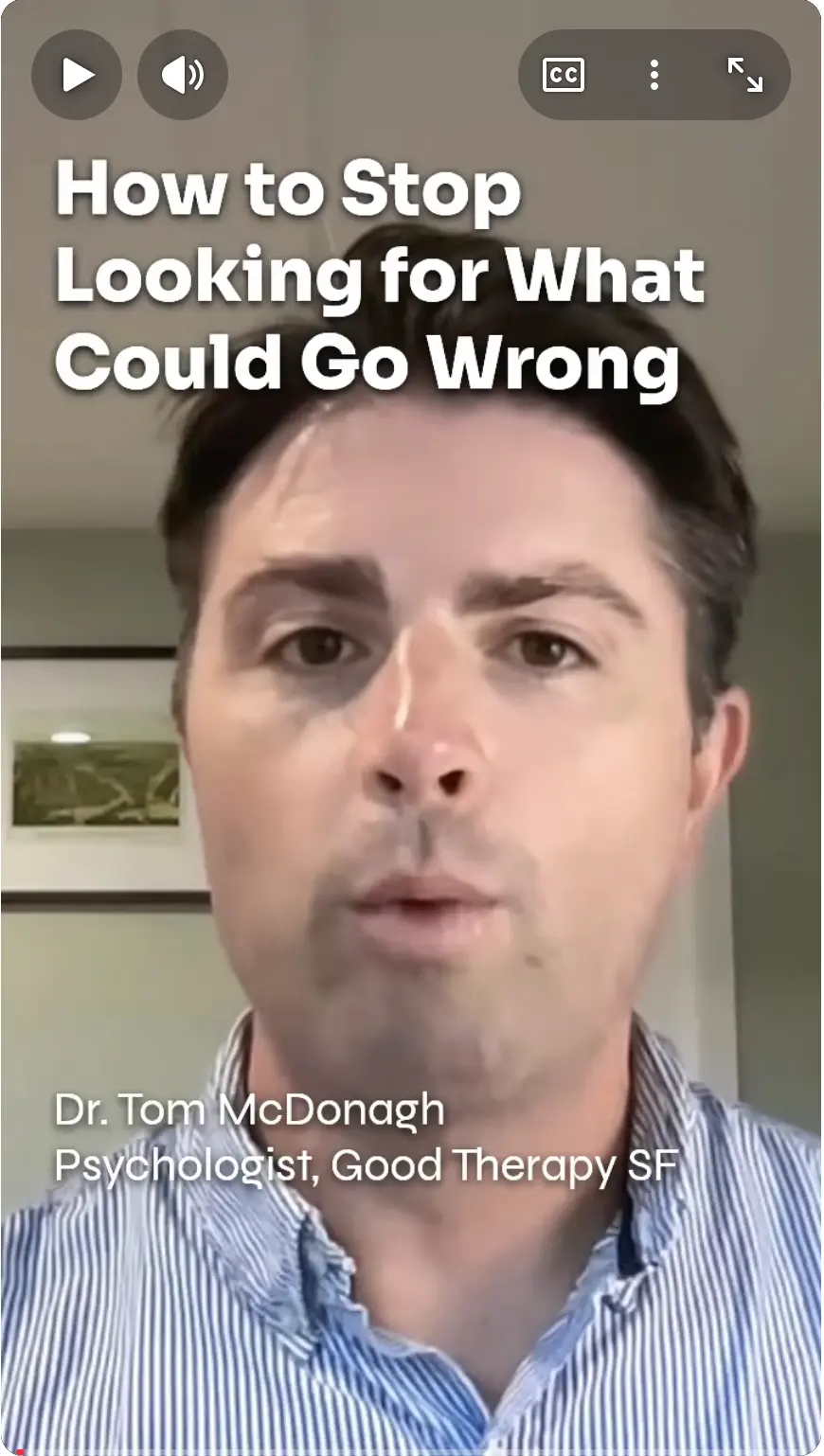


You check the calendar one more time before bed. You reread the message before you send it. You run through what could go sideways tomorrow, just so nothing catches you off guard.
It feels responsible. It feels like the price of being someone who does not drop things.
But a lot of people spend the entire day quietly checking for what might go wrong, and it is exhausting. It also does not usually make anything safer. Here is how to start loosening the habit.
Most people do not experience this as a choice. It runs underneath everything else, the way a background app runs without you opening it.
That is what makes it hard to change. You cannot step back from something you have not noticed you are doing.
So the first move is small. Name it while it is happening. Even calling it scanning, silently, gives you a little distance from it.
In sessions I often ask clients to catch it once a day and say what it was. Not to stop it. Just to see it. Most people are surprised by how often it turns up, and by how many of the checks were about things they had already handled.
Underneath the habit is usually one belief: if you see the bad thing coming, it will be easier to take.
That is worth examining, because it does not hold up. What actually happens is that you feel it now and again later. The scanning does not reduce the pain of the thing you are afraid of. It adds a rehearsal of it to every day in between.
This is close to what happens with catastrophic thinking, where the mind treats imagining a disaster as a way of preparing for it. Preparation is useful. Rehearsal is not the same thing, and your body cannot tell the difference.
Asking the question directly helps. What am I trying to avoid being surprised by? Sometimes the answer is something you can actually plan for. Often it is not, and seeing that is its own kind of relief.
This is the part that changes the habit rather than just explaining it.
Pick something low stakes and let it stay open. Do not reread the email before you send it. Do not confirm the reservation a second time. Choose something where the worst case is mild inconvenience.
You will feel the pull to check. That is the point. Learning to sit with a small unknown is how you build room for the bigger ones.
The discomfort fades faster than people expect, usually within twenty minutes or so. What you are teaching yourself is that the unknown was survivable without the check. That lesson does not come from thinking about it. It only comes from doing it.
A few things I suggest to clients working on this:
Give the habit a name. Scanning, checking, whatever fits. A name makes it a behavior you can observe instead of just how your mind is.
Ask what the surprise would cost. Often the honest answer is that being caught off guard would be uncomfortable, not dangerous. That distinction matters.
Start with one unchecked thing a day. Small and low stakes. This is practice, not a test of willpower.
Notice when scanning spikes. It usually climbs during uncertainty at work or after a real disruption. Knowing that keeps you from reading the spike as a sign you are getting worse.
Do not swap one check for another. Asking a friend for reassurance, or asking AI for it, works the same way as rechecking. The relief is real and it is brief, and the habit gets a little stronger each time.
If your mind is always looking for the next problem, that is worth talking through with someone. The therapists at Good Therapy SF work with San Francisco professionals dealing with anxiety, overthinking, and the sense that they can never quite put their guard down. Reach out to learn more.
About the Author
Dr. Tom McDonagh, PsyD, is a licensed clinical psychologist and the founder of Good Therapy SF. He trained at Vanderbilt and completed his postdoctoral work at Kaiser Permanente. His practice focuses on anxiety, OCD, panic, and work stress, with a special focus on San Francisco professionals. Good Therapy SF is located at 870 Market Street, Suite 617, San Francisco, CA.