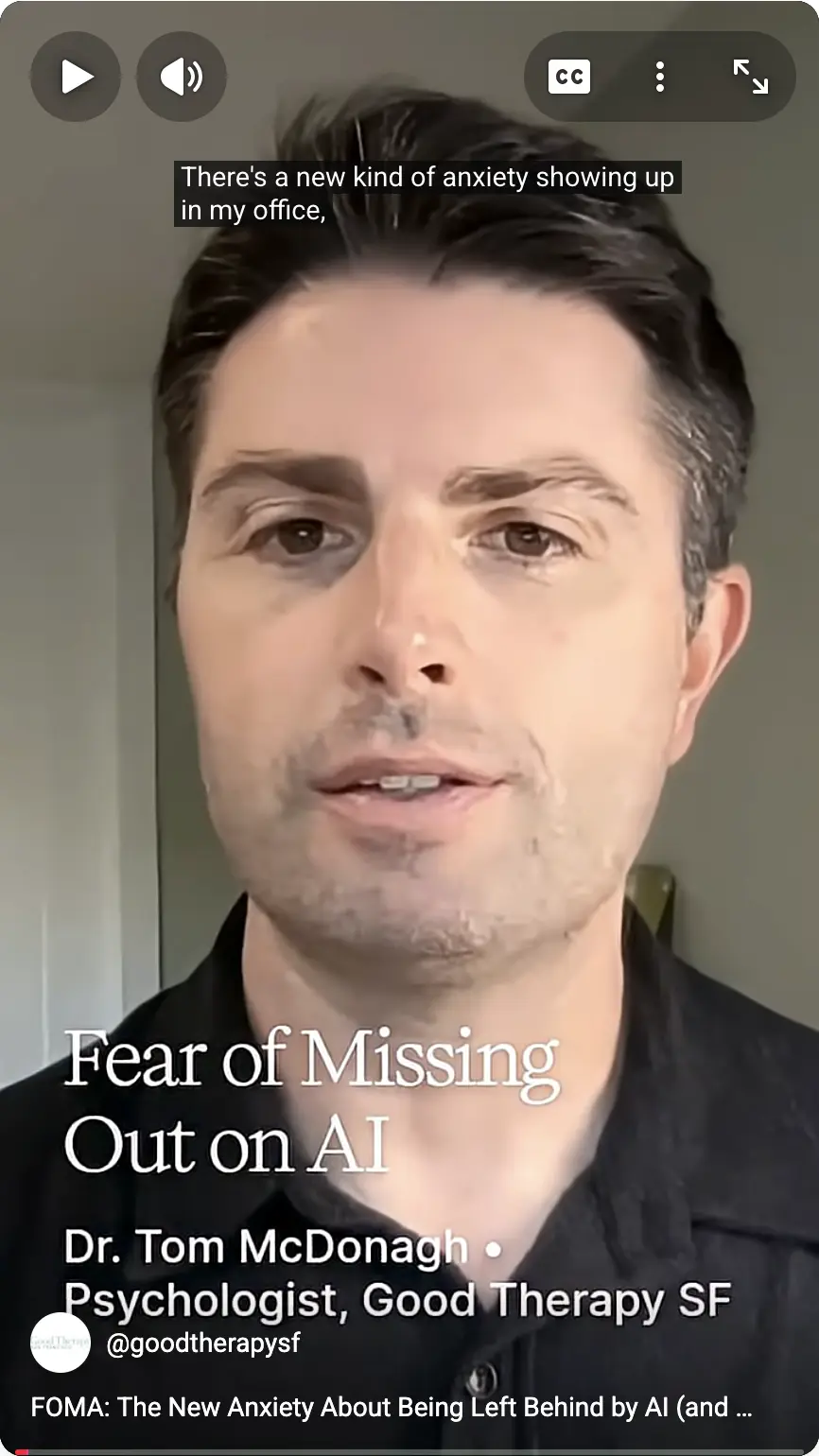
Most of us have done it by now. You have a hard conversation coming up, so you ask AI what to say. You are weighing a career move, so you run it through ChatGPT. You are not sure how to feel about something, so you ask Claude to tell you. Each step feels small and practical. But at some point, something shifts. You stop using AI to think more clearly and start using it to avoid thinking at all.
That shift is subtle, and it usually happens before you notice it.
It almost always starts with something reasonable. You draft a difficult email with AI’s help and it comes out better than what you would have written on your own. So next time, you skip the first draft entirely. Then you start running personal decisions through it. Then emotional questions. The tool gets more responsibility, and your own voice gets quieter with each handoff.
This is not a technology problem. It is a trust problem. Each time you defer to AI on something you could have handled yourself, you are sending a quiet signal to your brain: I do not trust my own judgment here. Over time, that signal accumulates.
AI responds to every question with the same calm, structured, authoritative tone. Whether you ask it to explain photosynthesis or tell you whether to leave your marriage, the delivery is identical. That consistency can feel reassuring, especially when you are anxious or uncertain.
But hard personal decisions are hard precisely because they involve your values, your history, and your specific relationships. Those are things no model can weigh for you. The confidence AI projects is a feature of how it communicates, not a reflection of how well it understands your situation. In my work with clients, I see this pattern regularly: someone receives a confident-sounding answer from AI and treats it as settled, even when their gut is telling them something different.
Judgment works like most psychological capacities. It gets stronger when you use it and weaker when you consistently outsource it. The more often you defer to AI on decisions that matter, the less practice you get sitting with uncertainty, weighing tradeoffs, and making calls on your own. And the less you practice, the less confidence you have the next time you try.
This is not hypothetical. I often explain it to clients this way: if you stopped walking for six months and used a wheelchair for convenience, your legs would not just be rested. They would be weaker. Judgment works the same way. Disuse has a cost.
The first sign is that you feel anxious making a decision without consulting AI first. When a tool moves from useful to load-bearing, that is worth noticing. A crutch is not a problem. Needing the crutch to walk is.
The second is that AI’s answer consistently overrides your instinct. There is a real difference between using AI to pressure-test your thinking and using it to replace your thinking. If you regularly abandon what your gut tells you in favor of whatever the model outputs, that pattern deserves some honest examination.
The third is that you have stopped sitting with uncertainty altogether. AI resolves ambiguity fast. But tolerating not knowing, staying with an open question long enough to let your own clarity emerge, is a core psychological skill. If that capacity is shrinking, it tends to show up across your life, not just in the moments where you are using AI.
The goal is not to stop using AI. It is a genuinely useful thinking tool, and there is nothing wrong with using it as one. The goal is to notice when the balance has tipped, when you are no longer thinking with AI but thinking through AI, and to reclaim the parts of your decision-making that belong to you.
That starts with small, deliberate choices to sit with a question before outsourcing it. To draft the email yourself first. To notice what your gut says before asking the model what it thinks. These are not dramatic interventions. They are practices that rebuild the muscle.
If you are finding it harder to trust your own judgment, or if anxiety is driving you to seek certainty from external sources more than feels right, therapy can help you sort through that. The therapists at Good Therapy SF work with people in San Francisco who are navigating exactly this kind of pattern. Reach out for a free 15-minute consultation.
Dr. Tom McDonagh is a licensed clinical psychologist and the founder of Good Therapy SF in San Francisco. He specializes in anxiety, OCD, depression, and burnout, with a particular focus on high-performing professionals in the Bay Area tech industry. Good Therapy SF is located at 870 Market Street, Suite 617, San Francisco, CA 94102.