Most people deciding to start therapy in San Francisco already have a thousand small logistical questions in mind. Where would I go. How would I get there. What would my week have to look like to actually fit it in. Underneath all of that is one bigger question that tends to drive the rest. Should I do this in person, or by video.
Both formats work. The research on outcomes is reasonably clear. For most concerns, what matters more than the format is the fit between you and the therapist. But that does not mean the choice is arbitrary. In-person and online therapy create different conditions for the work. Certain people get more out of one than the other.
This is one of the first things I talk through with new clients at Good Therapy SF. Here is what I usually walk them through.
There is a reason in-person therapy has been the default for so long. Coming into an office creates conditions that are hard to replicate at home. For some people, those conditions are doing real work in the background.
The biggest one is separation. You leave your apartment. You take Muni or walk a few blocks. You step into a room that is only used for this purpose. Your brain gets a clear signal that something specific is happening here. The session has a beginning and an end that are physical, not just on a calendar. Stepping back outside afterward is its own kind of decompression. For people who already struggle with work and personal life bleeding together, that boundary alone can be the difference between therapy feeling like real work and therapy feeling like another video call.
The second is what is in the room. In person, I can see body language, posture shifts, small changes in expression, and the way someone occupies a chair. Those signals are part of the data. Some are easy to read on a video call. Others are not. For deeper trauma work, EMDR, or anything that involves the body more directly, the in-person setting tends to do more.
The third is attention. In a session at the office, there are no tabs to half-check. No notifications to glance at. No roommate moving around in the next room. The environment supports being present in a way that home, especially a small San Francisco apartment, often does not.
Online therapy is not a watered-down version of the in-person experience. For some people, it is a better fit. And not just for convenience reasons.
The most obvious advantage is access. San Francisco is a city where a therapist appointment can mean an hour of round-trip travel. That cost is invisible at first. Six weeks in, you notice you have started canceling. Online removes the commute as a reason to drop out. That alone is one of the strongest predictors of whether therapy actually works. The best modality is the one you keep showing up for.
The second is comfort. Some people open up more easily from their own space. They are sitting in a chair they know, with their own things around them. The protective effort that goes into being in a new physical environment is not there. For social anxiety, generalized anxiety, and certain kinds of trauma work, that lower activation can let the actual material come up faster than it might in an unfamiliar office.
The third is range. When you are not limited to therapists within a 20-minute drive, you can match more carefully on specialty and fit. Maybe you need someone with specific OCD training. Maybe you want someone who works with bicultural identity. Maybe you want clinical experience with the particular shape of tech-industry burnout. Online opens up that selection.
In my work with clients, I rarely treat this as a clean either-or. The format is a tool. The right tool depends on what you are trying to do and what you can realistically sustain.
A few practical questions tend to clarify it.
What is your living situation. If you live alone in a quiet space, online can work very well. If you are sharing a small apartment with roommates or a partner, finding a private hour for a video session is its own logistical problem. The office becomes the privacy.
How do you handle transitions. Some people need the physical act of leaving and returning to actually feel that they have done a session. Others find the opposite. The friction of getting somewhere makes it harder to keep going. Knowing which you are is more useful than guessing what you should be.
What are you working on. For coaching-shaped work, skill building, or active anxiety management, online tends to be more than sufficient. For deeper trauma work or EMDR, in person is often a better starting point. We can also start in person and shift to online once a working rhythm is established. Or the other way around.
What does your week actually look like. If your schedule is unpredictable or you travel often, online keeps the work going through the disruption. If your schedule is stable and you live or work near the office, in person adds something useful.
None of these are deal-breakers in either direction. They are just the variables I want to make explicit before someone commits to a format that does not match the rest of their life.
At Good Therapy SF, we offer both. Our office is at 870 Market Street, Suite 617, in The Flood Building. It is walkable from most of downtown San Francisco. We also see clients across California by video, including Marin, the Peninsula, and the East Bay.
If you are not sure which is right for you, that is something we can talk through on a free 15-minute consultation. The goal of that call is not to pitch you on therapy. It is to give you enough information to make a sensible choice, even if that choice is not us.
If you would like to learn more about who you would be working with, you can meet our therapists. If you have questions about cost or insurance, we have written more about that on the cost of therapy and insurance pages.
Reach out when you are ready, and we will figure out the right fit together.
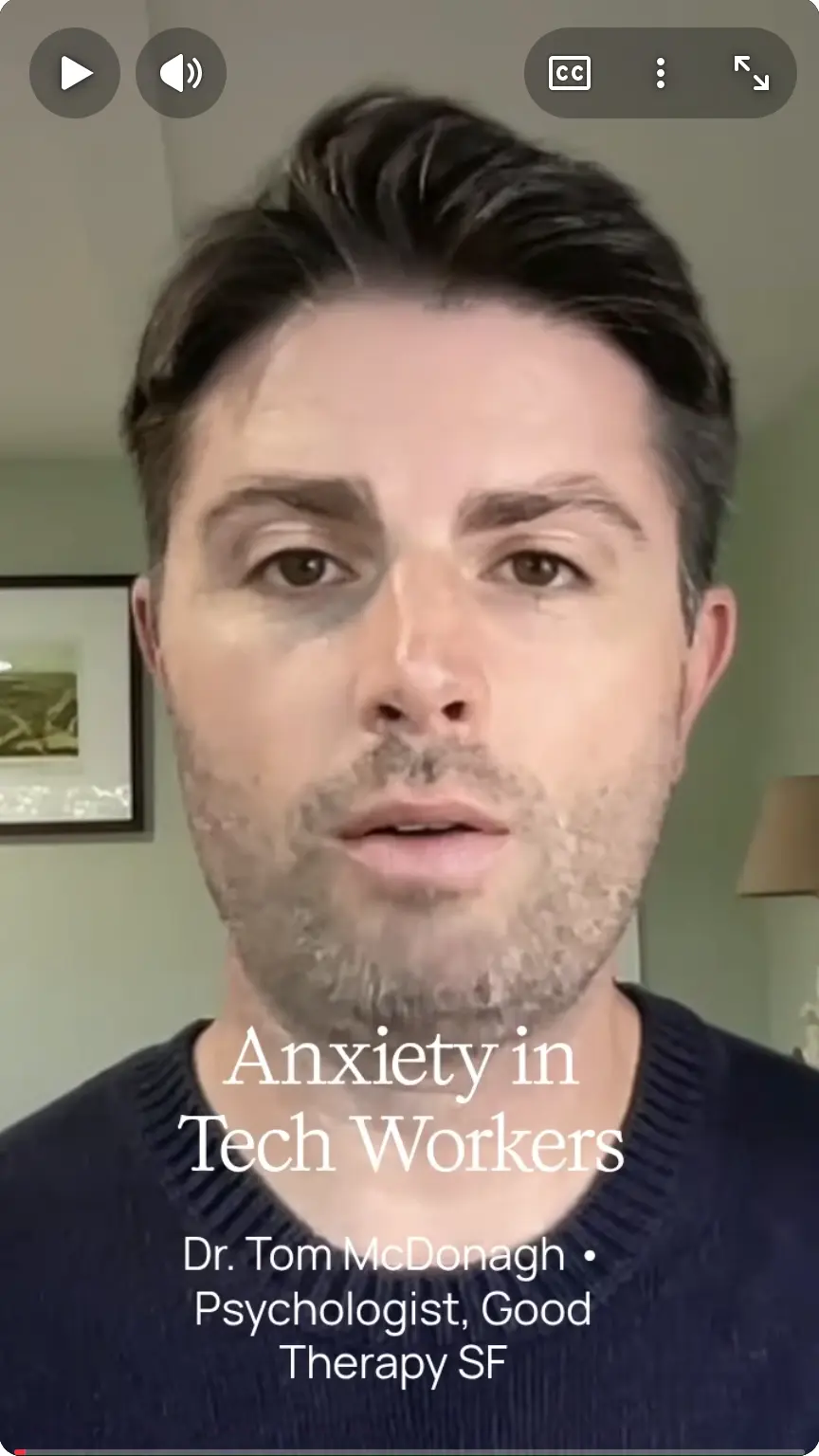
About the Author. Dr. Tom McDonagh is a licensed clinical psychologist and the founder of Good Therapy SF. His practice specializes in anxiety, burnout, OCD, depression, and related concerns, with a particular focus on the mental health of tech workers in San Francisco. Good Therapy SF is located at The Flood Building, 870 Market Street, Suite 617, San Francisco, CA 94102, and offers both in-person and online therapy across California.